
Astronomy has been around for thousands of years. In ancient times, people observed the sun and the stars on a daily basis. They planted crops and held certain events related to the movement of objects in the sky.
Ancient civilizations, like the Greeks and Romans, however, did not have the instruments that later generations had. They had to observe the skies and stars with their naked eyes. It helped them navigate the seas and guide them to other places. They saw that stars were arranged in patterns that looked like humans or animals.
In ancient times, people thought that the Earth was the centre of the universe and that everything revolved around it. Towards the end of the Middle Ages some astronomers were not quite convinced about this theory. In the early 16th century Nicolaus Copernicus, a Polish astronomer, was the first to show that, in fact , the sun was the centre of the solar system and planets revolved around it.
Almost a century later Italian astronomer Galileo used the first telescope to observe space. His studies supported Copernicus’ theories. German mathematician Johannes Kepler proved that planets travel around the sun in elliptical paths. Isaac Newton used Kepler’s findings to explain how gravity worked.
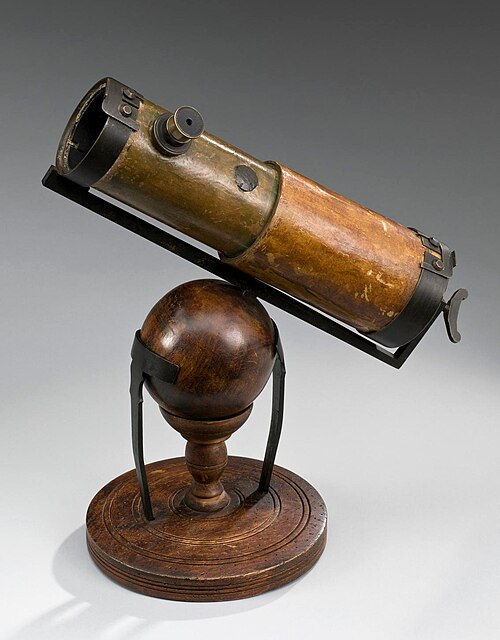
Isaac Newton’s second telescope
Image: The Science Museum UK, CC BY 4.0 via Wikimedia Commons
