
The discovery of the telescope changed the way scientists could observe space. While ancient people only were able to see objects near Earth, telescopes were able to find Uranus, Neptune and Pluto, the distant planets of our solar system. Astronomers also found that an asteroid belt moves around the sun between Mars and Jupiter. With the help of powerful telescopes, they were able to map the surface of the moon and other planets in great detail.
Modern astronomy uses powerful telescopes on Earth to see objects far away from our solar system. It also relies on images sent to Earth from orbiting telescopes, like the Hubble Space Telescope, which has been in operation since 1990.
Unmanned spacecraft that land on the moon and other planets give astronomers large amounts of data and images that they can use for their work. Astronomers also study samples of rocks that spacecraft have brought back to Earth.
Today, astronomers use computers to simulate movements and events that may happen in space. For example, they can predict how close an asteroid can come to Earth or when certain comets appear.
Astronomers measure distances in light years – how far light can travel in one year, which is about 6 trillion miles (9.4 trillion km). They have found out that our galaxy, the Milky Way, has a diameter of 100,000 light years. The nearest star is Proxima Centauri, about four light years away from Earth.
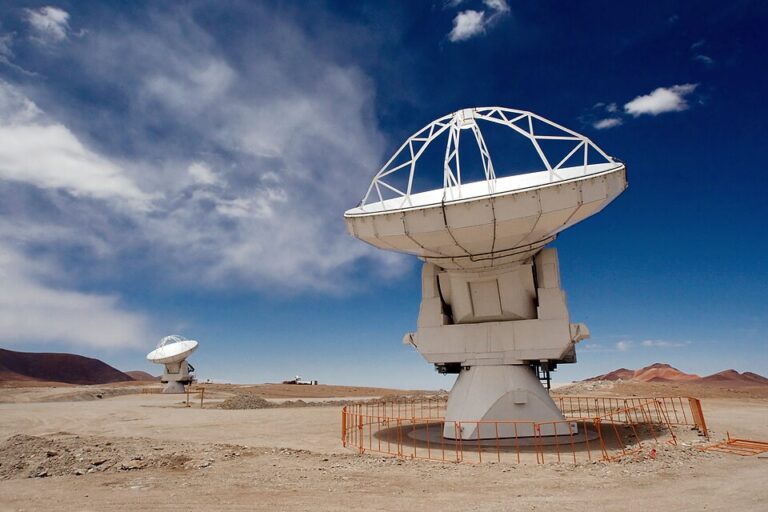
Radio telescope in the Atacama Desert
Image: Iztok Bončina/ESO, CC BY 4.0, via Wikimedia Commons

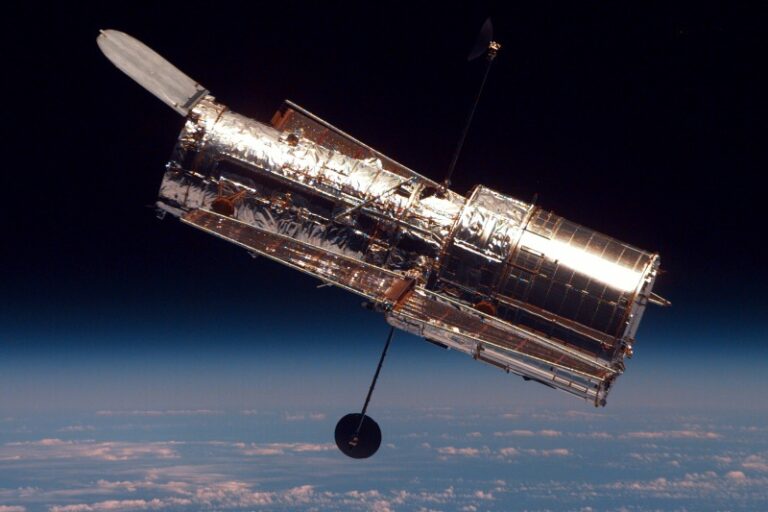
Hubble Space Telescope
Image: NASA, Public domain, via Wikimedia Commons
