
Shock Treatment
If the blood in your body does not circulate properly it may result in shock. Any serious injury or illness may also lead to shock. When a person is in shock blood does not carry enough oxygen and food to the brain and other organs.
A victim who suffers from shock may look afraid, confused, weak and extremely thirsty. The skin appears pale and feels cold. Pulse and breathing are fast.
To treat shock, place the victim on their back and raise their legs a little. Warm them with blankets.
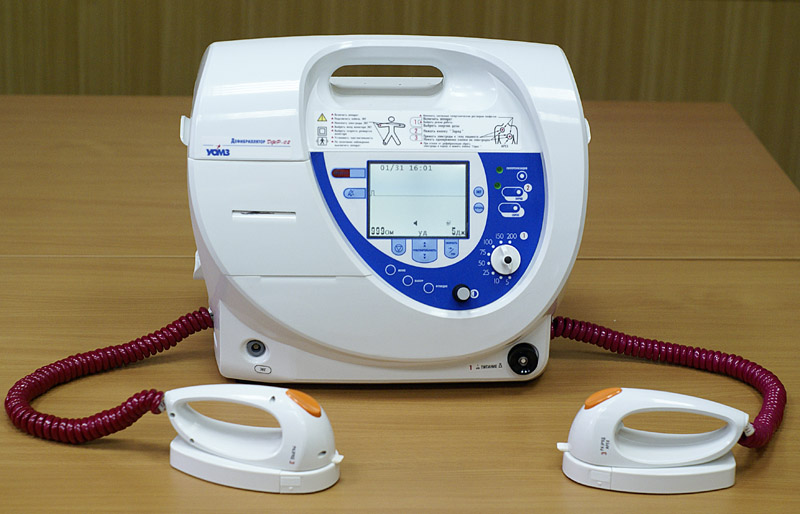
Defibrillator used to start a normal heartbeat if the heart stops beating
Image: Yury Masloboev / Yury Petrovich Masloboev), CC BY-SA 3.0 via Wikimedia Commons
.jpg)
Bleeding
Strong bleeding can cause death in minutes. Bleeding from small wounds usually stops after a short time because the blood clots. But clotting cannot stop the flow of blood when a wound is big.
The best way to stop bleeding is to press on the wound itself. If possible, let the person lie down and raise the bleeding part of the body. Then put a sterile handkerchief, cloth or towel on the wound and press it down with your hand. Do this for 10 to 20 minutes until help arrives. Sometimes direct pressure cannot stop strong bleeding. If a leg or an arm is hurt, you can try to stop bleeding by putting pressure on the artery that carries blood to the injured body part.
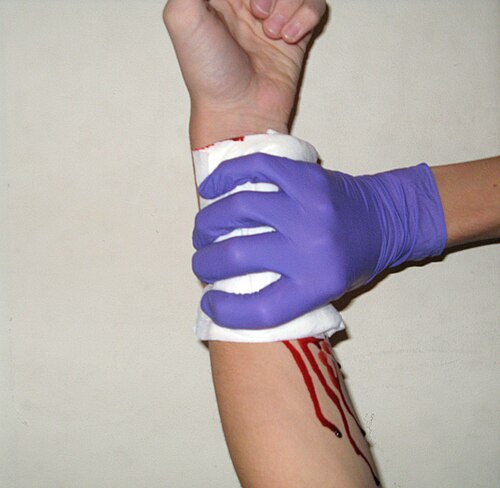
Put pressure on your arm to stop bleeding
Image: Mike6271, CC BY-SA 4.0 , via Wikimedia Commons

Poisoning
There are four ways in which a person may be poisoned. Poison can be swallowed, inhaled, injected, or absorbed through the skin. If a poison victim becomes unconscious or has difficulty breathing call for an ambulance immediately.
A person who has swallowed something poisonous may die within minutes if they are not treated. The first step is to find out what kind of poison someone has swallowed. Call a doctor or a poison control center immediately and follow the instructions that you are given carefully.
If a person has inhaled a poison like carbon monoxide or chlorine gas move them to fresh air at once. Open all doors and windows.
Injected poisons are those that come from insect stings or bites. If you are stung by a bee the stinger remains in the wound. Remove it carefully and put ice on the sting or run cold water over it. If a person is bitten by a tick pull out the remaining part carefully and slowly. Use a glove or something else but not your bare hands. Do not try to burn it off or put oil on it. If a rash or flu-like symptoms develop in the following weeks contact a doctor.
Sometimes a victim may have an allergy towards bites or stings. In such a case either call a doctor, an ambulance or take the person to the nearest hospital.
Poisons can also be absorbed through the skin if you get in contact with poisonous plants or chemical substances. If this happens, remove all the clothes that someone is wearing and flush the skin with water for about 10 minutes.
Artificial Respiration
Begin with artificial respiration as soon as possible if a person has stopped breathing. Two or three minutes without breathing can cause brain damage and six minutes can be fatal. The most efficient way is mouth-to mouth resuscitation. Put the victim on their back. Kneel down, press the nose together and place your mouth over the mouth of the victim. Take a deep breath and blow hard enough to make the chest rise. Then remove your mouth and listen for the air to come out. Repeat the procedure until the victim starts breathing again or help has arrived.
Burns
The first aid treatment of burns depends on how severe the burns are. First degree burns show a reddening of the skin. Second degree burns damage deeper skin layers and third-degree burns destroy tissue of deeper skin layers. To treat a first- and second-degree burn put ice on it or run cold water over it. Then put on sterile bandages. A person who has third degree burns should not be treated at home. When you treat burns never open blisters and do not put oil or other greasy substances on the burn.
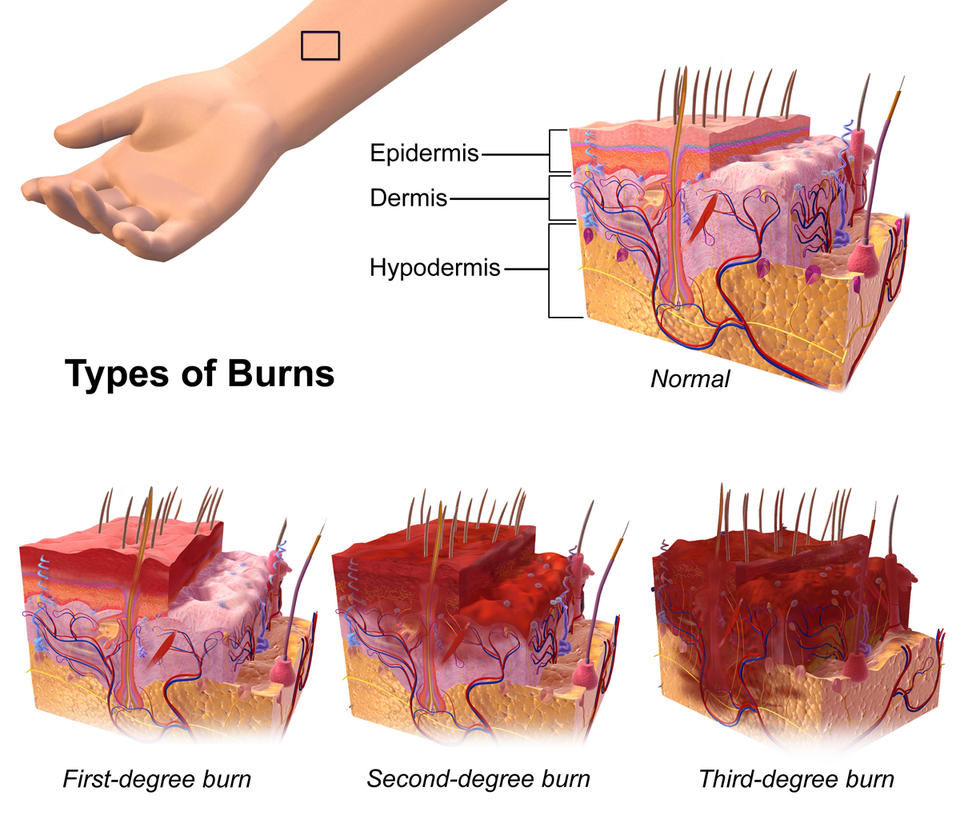
Types of burns
Image: BruceBlaus, CC BY-SA 4.0, via Wikimedia Commons

Frostbite
Frostbite occurs when a person has been in extremely cold weather for a long time. It mostly affects the skin of the ears, fingers, nose or toes. Frostbitten skin appears pale or grayish blue and feels numb. It should be treated gently. Warm the affected area with the heat of your hand or cover it with clothes until you can get the victim indoors. Thaw the skin by putting it in lukewarm water. Never use water that is hotter than 40°C. If you get blisters do not open them.