
Information
Astronomy is about studying space, the universe, stars and the planets in our solar system. Astronomers are scientists who try to find answers to questions relating to our universe. They observe planets, faraway stars and galaxies, as well as certain events that occur in space. They examine the structure of the universe and try to find out how it all began.
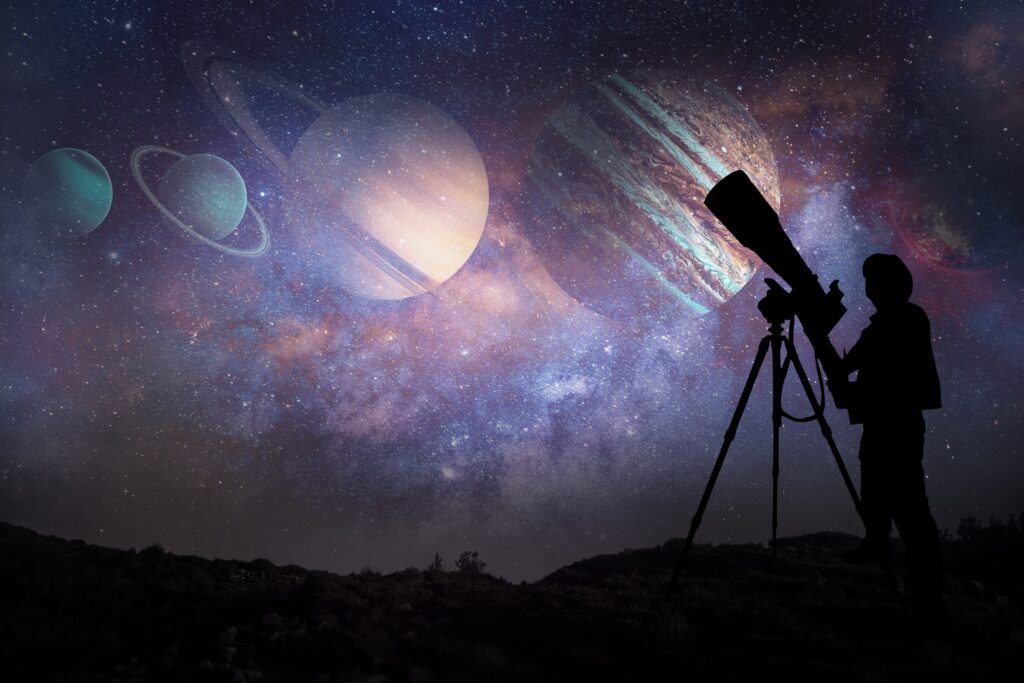
Image: PublicDomainPictures.net
Astronomy has been around for thousands of years. In ancient times, people observed the sun and the stars on a daily basis. They planted crops and held certain events related to the movement of objects in the sky.
Ancient civilizations, like the Greeks and Romans, however, did not have the instruments that later generations had. They had to observe the skies and stars with their naked eyes. It helped them navigate the seas and guide them to other places. They saw that stars were arranged in patterns that looked like humans or animals.
In ancient times, people thought that the Earth was the centre of the universe and that everything revolved around it. Towards the end of the Middle Ages some astronomers were not quite convinced about this theory. In the early 16th century Nicolaus Copernicus, a Polish astronomer, was the first to show that, in fact , the sun was the centre of the solar system and planets revolved around it.
Almost a century later Italian astronomer Galileo used the first telescope to observe space. His studies supported Copernicus’ theories. German mathematician Johannes Kepler proved that planets travel around the sun in elliptical paths. Isaac Newton used Kepler’s findings to explain how gravity worked.
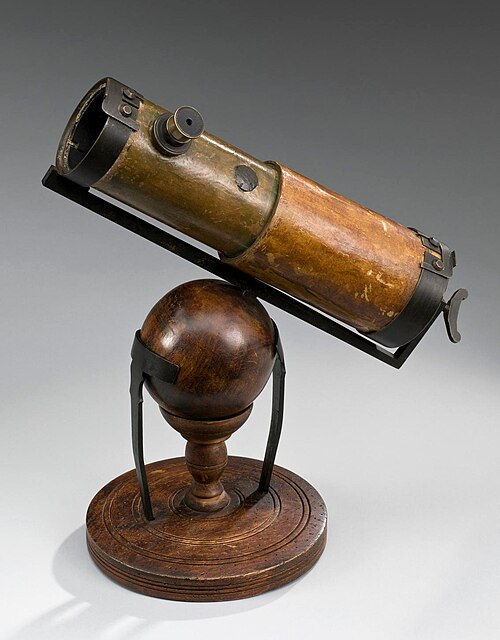
Isaac Newton’s second telescope
Image: The Science Museum UK, CC BY 4.0 via Wikimedia Commons

The discovery of the telescope changed the way scientists could observe space. While ancient people only were able to see objects near Earth, telescopes were able to find Uranus, Neptune and Pluto, the distant planets of our solar system. Astronomers also found that an asteroid belt moves around the sun between Mars and Jupiter. With the help of powerful telescopes, they were able to map the surface of the moon and other planets in great detail.
Modern astronomy uses powerful telescopes on Earth to see objects far away from our solar system. It also relies on images sent to Earth from orbiting telescopes, like the Hubble Space Telescope, which has been in operation since 1990.
Unmanned spacecraft that land on the moon and other planets give astronomers large amounts of data and images that they can use for their work. Astronomers also study samples of rocks that spacecraft have brought back to Earth.
Today, astronomers use computers to simulate movements and events that may happen in space. For example, they can predict how close an asteroid can come to Earth or when certain comets appear.
Astronomers measure distances in light years – how far light can travel in one year, which is about 6 trillion miles (9.4 trillion km). They have found out that our galaxy, the Milky Way, has a diameter of 100,000 light years. The nearest star is Proxima Centauri, about four light years away from Earth.
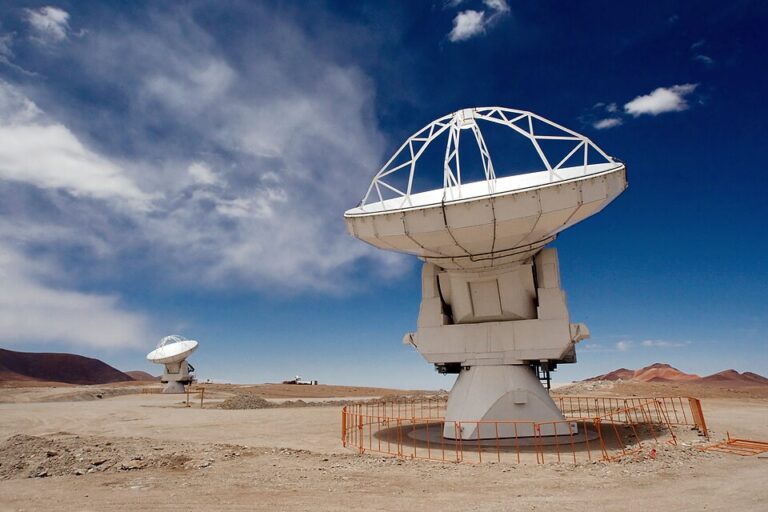
Radio telescope in the Atacama Desert
Image: Iztok Bončina/ESO, CC BY 4.0, via Wikimedia Commons

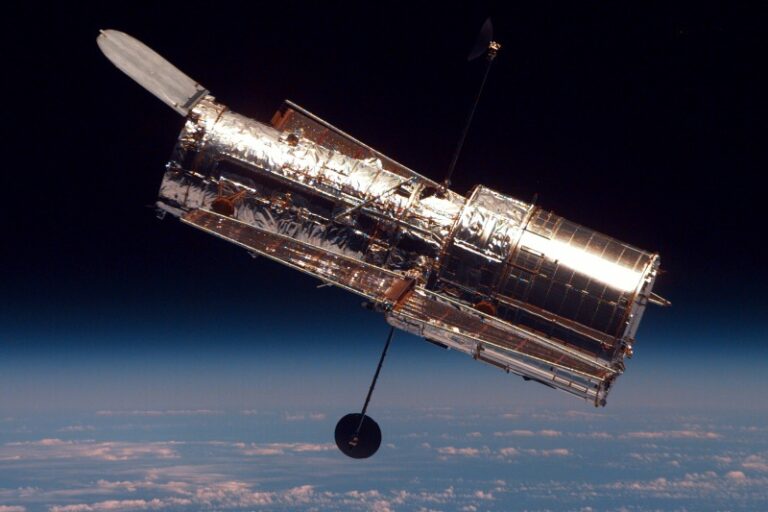
Hubble Space Telescope
Image: NASA, Public domain, via Wikimedia Commons

- ancient = here: a long time ago
- ancient = old
- arrange= to put into a special position or order
- asteroid belt= many small rocky objects that move around the sun between Mars and Jupiter
- century = a hundred years
- certain = special
- comet = an object in space that looks like a bright ball with a long tail; it moves around the sun
- convince= to prove to someone that what you say or think is true
- crop= plant, like wheat, corn or rice, which is grown by farmers and used as food
- data = information
- diameter= straight line from one side of a circle to the other
- discovery= when you find something new, that was not known before
- distant = far away
- elliptical path= route that moves around an object in an ellipse
- examine= look at very carefully
- explain = make clear
- finding= discovery, result
- galaxy= one of the large groups of stars that make up our universe
- gravity = the power that causes an object to fall to the ground; it also pulls things to other planets
- however = but
- image = picture
- in fact = the truth is; in reality
- in great detail= here: to put in a lot of information
- in operation = here: working
- later = future
- map = draw
- measure= to find out how far away something is
- movement= when an object moves
- naked eye=to see something without anything to help you
- navigate = to find out which way you need to go
- observe = watch closely
- occur = happen
- on a daily basis = every day
- orbit = to move around
- pattern = design, shape
- predict= say that something will happen in the future
- prove= to show that something is true
- relating to = about something
- rely = depend on; need
- revolve = move around
- sample= here: rock ; piece of something from another planet
- scientist= person who has studied science and works in a laboratory
- simulate=to make something feel real
- solar system = the sun and the planets that move around it
- support = back up ; help
- surface= the top part of something
- telescope = object that is shaped like a tube and used to make faraway things look closer and bigger
- trillion = 1,000,000,000,000
- unmanned spacecraft= object that can travel into space without anybody guiding it