
In prehistoric times, people were hunters and travelled around. They never lived in one place. As they started to grow crops and raise animals, they settled in villages, which later grew into larger towns.
Ancient Cities
The first real cities emerged in Mesopotamia about 5,000 years ago. In ancient cities, people were not only farmers, they also were craftsmen. People lived together in larger houses or buildings. Many cities had walls around them that protected the inhabitants from enemies. The central part of the city included a temple or a place to pray.
The biggest ancient city was Rome. Up to one million people lived there. In many aspects Rome was a modern city with streets, marketplaces, arenas, parks, and even a sewage system.
The people in ancient cities were divided into classes. Government officials, soldiers, and priests belonged to the upper classes. The middle and lower classes were made up of merchants, farmers, and craftworkers. Newcomers and slaves had to live outside the city and were seen as outcasts.
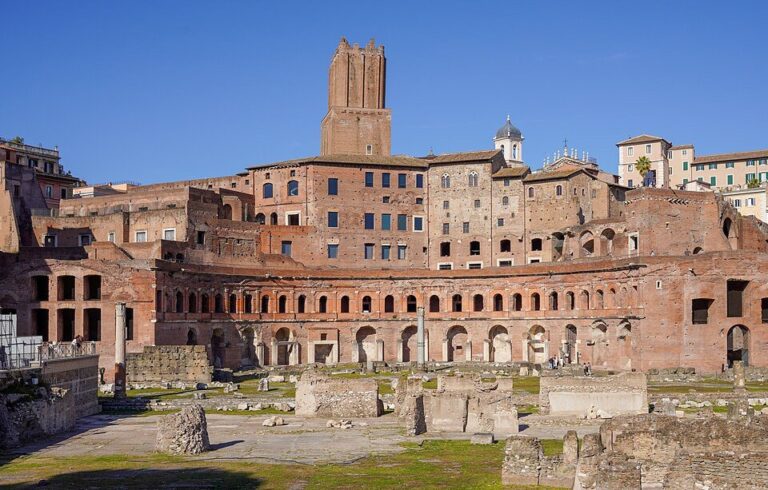
Trajan’s market in Ancient Rome
Image: “Trajan’s market”, by NikonZ7II, via Wikimedia Commons, Licence: CC BY-SA 4.0
Medieval Cities
After the fall of the Roman Empire, the population of cities fell. Trading between cities, which the Romans started, stopped again.
Medieval cities were small in size. The centre was often occupied by a Gothic cathedral, the city’s main church. It was the most expensive building in the city and showed that religion was very important during the Middle Ages.
As in ancient cities, medieval ones were dirty and diseases spread quickly. Land in the city was very expensive. Cities could not expand because of the surrounding walls. In some cases, city governments tore down the walls and rebuilt them farther away from the city.
During the Middle Ages, members of the family, servants, and workers often lived in the same house. Craftworkers and merchants were organized in guilds, a new economic class in the cities. There were guilds for bakers, goldsmiths, tailors and other groups.
Towards the end of the Middle Ages, trade started to become important again. Venice, one of the biggest cities of the time, became a centre of trade in the Mediterranean region. Other trading centres included northern German cities, Hamburg and Lübeck, Antwerp in Belgium and London.
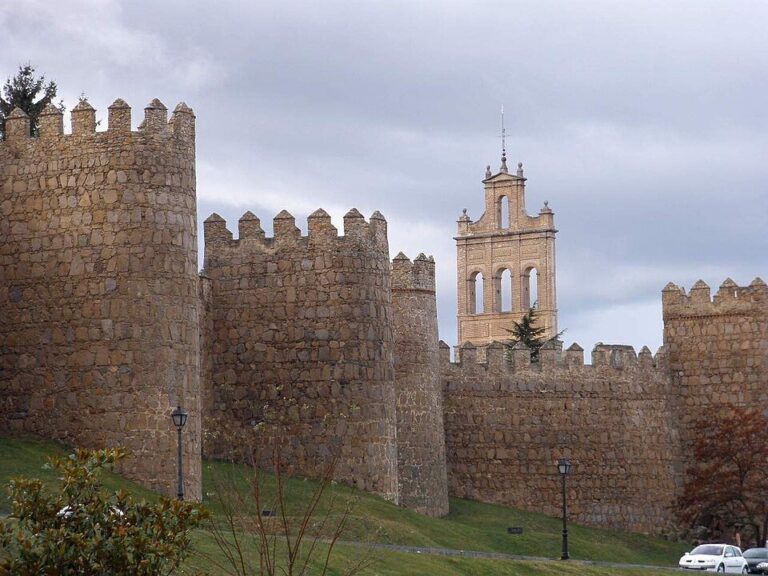
Medieval walls in Avila, Spain
Image: “Avila – Murallas, Paseo de la Ronda Vieja”, by Zarateman, via Wikimedia Commons, Licence: CC0, Public Domain
Industrial Cities
The Industrial Revolution and the growth of factories changed the lives of many people. Many people started to leave their farms in the countryside and moved to the cities, where they hoped to get jobs in new factories. Machines could do work much more quickly than people. Many skilled craftworkers lost their work.
The industrial city focused on factories, warehouses, railway lines and harbours. Workers lived in cheap terraced houses. The central parts of the city were very crowded; the air was polluted by the smoke coming out of the factories. Garbage and rusting metal was dumped everywhere. Factory workers had tiring jobs, in which they worked up to 16 hours a day. Only few people became rich during the Industrial Revolution. Factory owners made big profits and built themselves houses outside the city.
Modern Cities
In the 20th century, cities grew more than ever before. By building skyscrapers, architects discovered a new way to get more space in the city.
As time went on, more and more people moved away from the inner parts of the city and settled down in the suburbs, which were places where it was quieter and where the quality of life was better. These suburbs became small towns with their own office buildings and shopping centres. Residents can work and live there without having to travel long distances to the centre. Poorer people, however, stayed in the centres and formed ghettos. They lacked the money to buy houses or flats in the more expensive suburbs.
Today’s cities are much larger than cities in previous times. With the help of cars and public transport, people can get to all parts of a city very quickly.
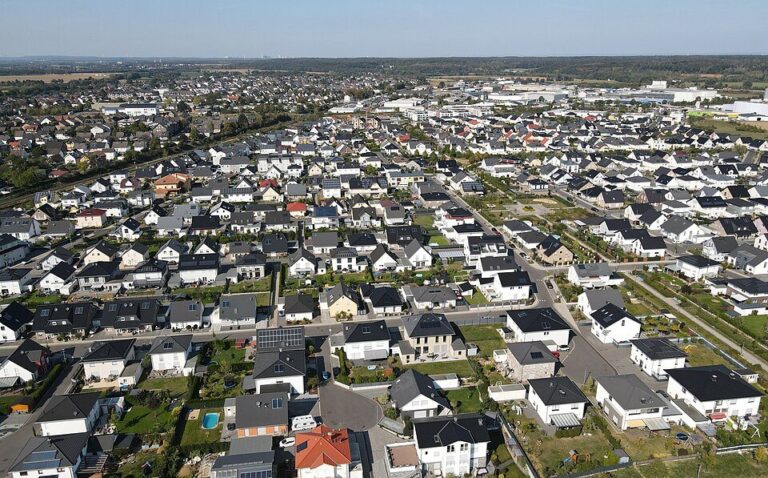
Weilerswist, suburb of Cologne, Germany
Image: “WeilerswistSued.jpg”, by Cekay, via Wikimedia Commons, Licence: CC BY-SA 4.0